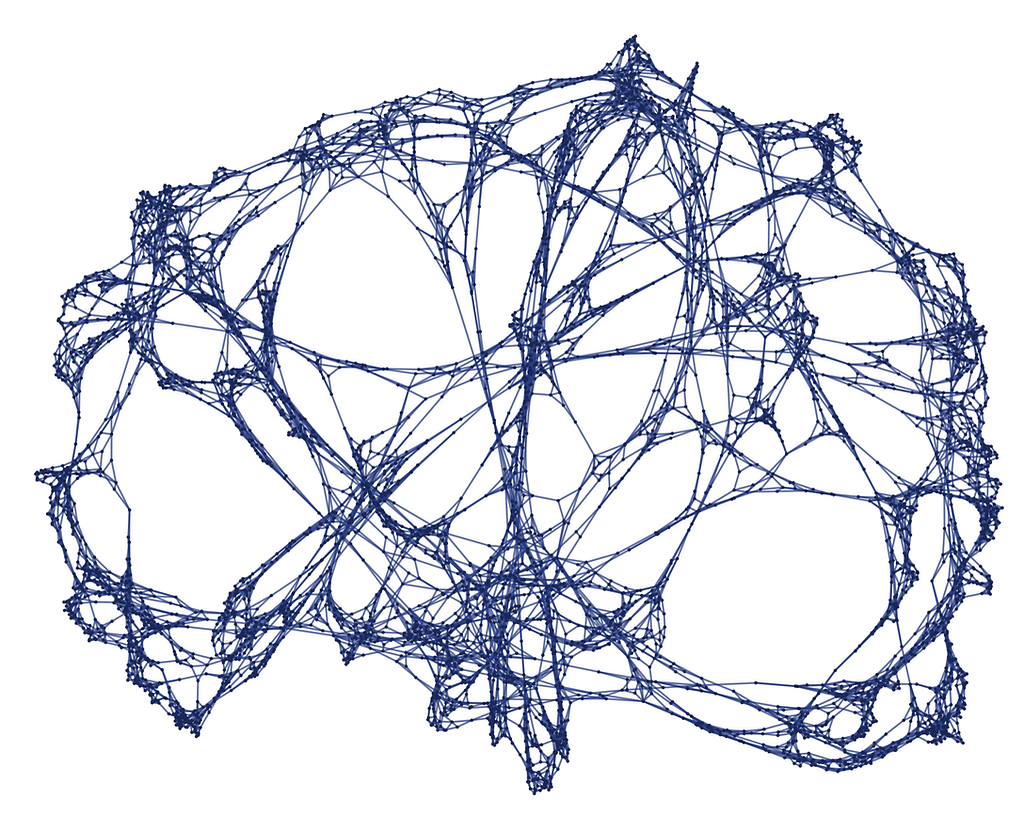
Someone sent me a link to a blog post by Stephen Wolfram. I skimmed it and came up with the following review.
The post is… interesting. It starts out in a typically annoying Wolfram way (everything is about him and he’s done something unique and brilliant) but the (hyper)graph computations are quite compelling.
Are you familiar with Conway’s Game of Life? (If not, just Google it and click on the Wikipedia link.) Wolfram is using a similar idea, but instead of a cellular automaton he uses graph rewriting rules, and there is nondeterminism in the latter. And where Life has a single fixed rule to compute the next generation (which I suppose Conway experimentally picked so that the results would be most interesting and unpredictable), Wolfram doesn’t pick one rule but instead has a general form to which the rule (or rules?) for a particular “universe” must conform, and then explores various rules.
This is like Conway experimenting with different rules for his game, except for cellular automata there aren’t that many possible rules, and I’m sure most rules lead to very boring universes. In Wolfram’s case I’m sure there are also a lot of boring universes, but his system allows many more different rules (and of course his examples have all been picked to be “interesting”).
Another big difference between Conway’s multiverse and Wolfram’s is that in a Conway universe, all cells change in lock step, whereas in a Wolfram universe, in each step a single rule application is selected from all possible rule applications, producing nondeterminism.
What’s interesting is that in some (most?) universes he’s looked at, often different sequences of choices end up producing the same state. Of course, at this point Wolfram sees this as a parallel to the nondeterminism in quantum mechanics, and he manages to link things to all the big ideas of physics, like general relativity and time.
In Wolfram’s view, physics made a “wrong turn” in believing that time is symmetrical (the equations of actual physics work the same forward and backward) and that as a dimension it is equivalent to the three spatial dimensions. Here I have a hard time believing Wolfram — I have the same intuition (since of course we experience time as asymmetrical), but that doesn’t mean it’s true in the philosophical/physical sense. Physicists explain the apparent asymmetry of time using entropy, and what Wolfram is observing in his simulated universes is probably no different.
Is there a connection with actual physics? I doubt it — it’s just another fun simulation game, and we can have a lot of fun with it (like I had with Conway’s Life when I learned about it in my freshman or sophomore year), but it’s not really helping us understand the universe we live in other than at a metaphorical level.